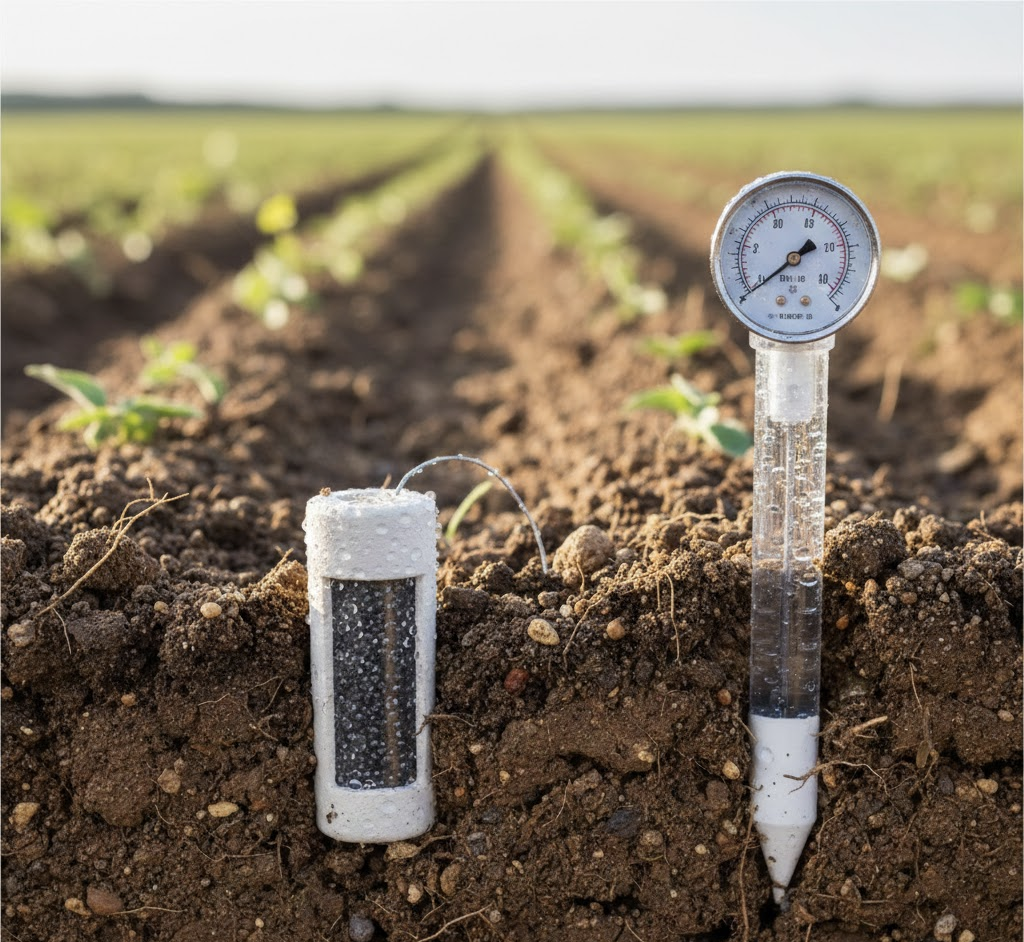
If you have ever over-irrigated a field because your moisture readings looked “dry” on paper, or lost a crop to waterlogging because a sensor told you the soil was only at 40% volumetric water content, you already know the core problem: raw moisture percentage does not tell you whether plants can actually access that water. Soil water tension does. And for growers who need a reliable, low-maintenance way to measure tension across thousands of hectares, granular matrix sensors have become the workhorse tool of modern irrigation management.
This guide covers how granular matrix sensors work at a hardware level, how to interpret their centibar readings, and when they outperform tensiometers - or fall short. We will get specific with numbers, soil types, and real installation guidance so you can make a confident decision for your operation.
Why Soil Water Tension Matters More Than Volumetric Water Content
Volumetric water content (VWC) tells you how much water is in the soil. Soil water tension (SWT), measured in centibars (cb) or kilopascals (kPa), tells you how hard a plant root has to work to extract that water. The distinction is critical.
Consider two fields: one sandy loam, one heavy clay. Both read 30% VWC. In the sandy loam, that 30% means the soil is near field capacity - plants are comfortable. In the heavy clay, 30% VWC could mean the soil is gripping that water so tightly (60+ cb) that roots are already stressed. Same number, completely different plant experience.
Soil water tension normalizes across soil types. A reading of 30 cb means roughly the same thing for plant water availability whether you are in sand, loam, or clay. That is why tension-based sensors - tensiometers and granular matrix sensors - remain the preferred choice for irrigation scheduling, even as capacitance and TDR sensors have flooded the market.
How Granular Matrix Sensors Work
Internal Structure
A granular matrix sensor - the most widely known being the Watermark 200SS - is deceptively simple in construction. Inside a cylindrical stainless steel housing (typically 22 mm diameter, 76 mm long), you will find:
- Two concentric electrodes - stainless steel wires embedded in the sensing medium
- A granular matrix - a precisely engineered mixture of silica sand and gypsum compressed into a solid disc
- A synthetic membrane - surrounding the granular matrix, allowing water to pass in and out while keeping soil particles from clogging the matrix
- A stainless steel mesh screen - the outer protective layer that provides structural integrity and soil contact
The gypsum component is not just structural. It serves a specific electrochemical purpose: buffering the electrical conductivity of the pore water against variations in soil salinity. Without the gypsum, a resistance-based sensor would confuse saline water (low resistance) with wet soil (also low resistance). The gypsum dissolves very slowly, maintaining a baseline conductivity that makes the resistance measurement primarily a function of water content rather than dissolved salts.
Measurement Principle
The operating principle is electrical resistance measured through a porous medium in hydraulic equilibrium with the surrounding soil.
When the soil is wet, water moves into the granular matrix through the membrane via capillary forces until the matrix reaches the same water tension as the surrounding soil. More water in the matrix means more conductive pathways between the electrodes, which means lower electrical resistance.
As the soil dries, water moves out of the matrix back into the soil. Fewer conductive pathways remain. Resistance increases.
The sensor’s reader or data logger applies a small AC excitation signal (typically 50-100 Hz) across the electrodes, measures the resulting resistance (ranging from roughly 550 ohms at saturation to over 35,000 ohms when dry), and converts that resistance to a soil water tension value in centibars using a calibration curve developed by Irrometer Company.
Temperature Compensation
Electrical resistance changes with temperature - roughly 2% per degree Celsius. Quality granular matrix sensor readers include an internal temperature compensation algorithm. When connecting to an IoT data logger, you should pair each Watermark sensor with a soil temperature sensor (installed at the same depth) and apply the Shock, Barnum & Searing (SBS) equation or the simplified Irrometer formula:
SWT (kPa) = -(f(R) adjusted for T)
Where R is resistance in ohms and T is soil temperature in Celsius. Most modern data loggers handle this automatically, but if you are building a custom system, failing to compensate for temperature will introduce errors of 10-20% between a cool morning reading and a hot afternoon reading.
Reading and Interpreting Centibars
Centibar readings are straightforward once you internalize the scale. Here is the practical reference table we use across our deployments:
| Centibar Range | Soil Condition | Action |
|---|---|---|
| 0-10 cb | Saturated - free water present | Stop irrigation. Risk of root disease and nutrient leaching. |
| 10-20 cb | Field capacity - ideal for most crops | No irrigation needed. Soil is holding maximum useful water. |
| 20-40 cb | Adequate moisture | Monitor. Good range for established trees and vines. |
| 40-60 cb | Moderate stress beginning | Irrigate shallow-rooted crops (vegetables, strawberries). |
| 60-100 cb | Significant water stress | Irrigate most crops. Trees and vines showing reduced growth. |
| 100-150 cb | Severe stress | Yield loss occurring. Irrigate immediately. |
| 150-200 cb | Extremely dry | Approaching permanent wilting point in many soils. |
Irrigation Trigger Points by Crop Type
The right trigger depends on the crop and its sensitivity to water stress:
- Vegetables and strawberries: Irrigate at 25-35 cb. These shallow-rooted, high-value crops cannot tolerate even moderate stress without yield loss.
- Corn and soybeans: Irrigate at 50-70 cb during vegetative growth; tighten to 40-50 cb during tasseling/flowering.
- Tree fruits (citrus, avocado, apple): Maintain 30-50 cb in the root zone. Citrus is particularly sensitive - do not let readings exceed 60 cb.
- Wine grapes: Managed deficit irrigation often targets 80-120 cb deliberately to improve berry concentration. This is one crop where “dry” is sometimes the goal.
- Alfalfa and pasture: Irrigate at 70-100 cb. These deep-rooted crops tolerate more tension before yield declines.
Granular Matrix vs Tensiometer: When to Use Each
This comparison comes up in nearly every consultation. Both measure soil water tension, but they are fundamentally different tools with different strengths.
| Feature | Granular Matrix Sensor | Tensiometer |
|---|---|---|
| Measurement principle | Electrical resistance in porous medium | Vacuum in water-filled tube with ceramic tip |
| Accuracy | ±10-15% of reading | ±1 cb |
| Measurement range | 0-200 cb | 0-80 cb (breaks suction above ~85 cb) |
| Response time | 1-4 hours to reach equilibrium | 15-60 minutes |
| Maintenance | None - install and forget | Weekly refilling, air bubble purging |
| Lifespan | 5-10 years | 1-3 years (ceramic tips degrade) |
| Sensor cost | $30-50 USD per unit | $80-200 USD per unit |
| Salinity tolerance | Good - gypsum buffering up to ~6 dS/m | Excellent - not affected by salinity |
| Best soil types | All types, especially good in coarse soils | Best in fine-textured soils (clay, silt loam) |
| IoT compatibility | Excellent - simple resistance output | Moderate - requires pressure transducer add-on |
| Installation difficulty | Easy - push into augered hole | Moderate - requires careful water filling |
When Tensiometers Win
Choose tensiometers when you need high-accuracy tension readings in the 0-60 cb range and have staff available for weekly maintenance. They excel in:
- High-value greenhouse production where ±1 cb precision translates directly to crop quality
- Research plots where data accuracy matters more than convenience
- Fine-textured soils (clay, silty clay) where the operating range of 0-80 cb covers the full irrigation management window
- Saline environments above 6 dS/m where granular matrix sensors lose reliability
When Granular Matrix Sensors Win
Choose granular matrix sensors when you need reliability over precision and cannot visit sensors weekly. They dominate in:
- Remote or large-scale operations - hundreds of sensors across thousands of hectares with no maintenance visits
- Sandy and loamy soils where tension routinely exceeds 80 cb between irrigations
- Dryland farming where you need to monitor deep into the dry range (100-200 cb)
- IoT and automated systems - the simple two-wire resistance output integrates directly with any data logger or controller
- Perennial crops - install once, read for 5-10 years without touching the sensor
Soil Type Considerations
The same centibar reading means different things in terms of available water depending on your soil texture. Here is why:
Sandy soils hold less total water, so a shift from 20 cb to 50 cb represents a larger percentage of available water being depleted. In sand, irrigate earlier - by 30-40 cb - because the remaining buffer is thin. Granular matrix sensors work exceptionally well in sand because readings frequently exceed the 80 cb tensiometer limit.
Loam soils are the sweet spot for granular matrix sensors. The moderate water-holding capacity means readings move predictably through the 10-80 cb range during a typical irrigation cycle, giving you clear signals for irrigation timing.
Clay soils hold water tightly. A reading of 40 cb in clay still represents a significant volume of available water - more than the same reading in sand. You can push irrigation triggers higher (50-70 cb) in clay. However, be aware that granular matrix sensors respond more slowly in clay because water moves slowly through fine pores. In heavy clay, a tensiometer’s faster response may be worth the maintenance trade-off.
Saline soils (EC above 4-6 dS/m) challenge granular matrix sensors because high salt concentrations lower resistance independently of water content, making soil appear wetter than it is. If your soil or irrigation water salinity exceeds 6 dS/m, either use tensiometers or apply a correction factor based on concurrent EC measurements.
Installation Guide
Proper installation determines whether your sensor data is useful or misleading. Follow these steps:
Conditioning (Do Not Skip This)
Before installation, soak each granular matrix sensor in clean water for 24-48 hours. The internal granular matrix must be fully saturated before first use. Without conditioning, the gypsum matrix takes weeks to equilibrate in the field, and your initial readings will be unreliable.
After soaking, remove the sensor from water and let it air-dry for 24 hours. Then re-soak for another 12 hours. This wet-dry-wet cycle activates the gypsum surface and ensures proper hydraulic contact within the matrix.
Depth Recommendations
Install sensors at multiple depths to understand the full root zone profile:
- Shallow sensor: 15-20 cm (6-8 inches) - captures surface drying and rainfall/irrigation infiltration
- Mid-root zone sensor: 30-45 cm (12-18 inches) - primary irrigation management depth
- Deep sensor: 60-90 cm (24-36 inches) - monitors deep percolation and whether roots are accessing deep moisture
For shallow-rooted crops (lettuce, strawberries), two depths (15 cm and 30 cm) are sufficient. For tree crops, add a fourth sensor at 120 cm to track deep drainage.
Placement Tips
-
Auger a hole slightly larger than the sensor diameter (25 mm auger for a 22 mm sensor). Make a slurry of native soil and water, pour it into the hole, then push the sensor into the slurry. This eliminates air gaps that would insulate the sensor from the soil.
-
Place sensors in the active root zone, not between rows or at the field edge. For drip irrigation, install sensors 15-20 cm from the emitter - close enough to be in the wetted zone, far enough to avoid measuring the saturated bulb directly under the dripper.
-
Avoid rocky or compacted spots. Air pockets around the sensor body will cause artificially high (dry) readings.
-
Mark sensor locations clearly with flags or GPS coordinates. Buried sensors are easy to lose, especially after tillage.
-
Route cables carefully to avoid rodent damage. Use conduit where possible, and leave a service loop at the sensor so cable tension does not pull the sensor out of position.
IoT Integration: From Sensor to Automated Irrigation
Granular matrix sensors are among the easiest soil sensors to integrate into an IoT system. The two-wire output requires no complex protocols - just a resistance measurement that any analog-to-digital converter can handle.
Connecting to Controllers
A typical setup pairs multiple Watermark sensors with a field data logger or controller. The Watermark 200SS sensor outputs a resistance signal that connects directly to our controllers via a simple two-wire cable run. No signal conditioning boards, no SDI-12 protocol overhead - just wire it, configure the channel, and start reading.
For larger operations, deploy one controller per irrigation zone with 3-6 sensors per zone (two depths at three locations). This gives you spatial and depth coverage to make confident irrigation decisions rather than relying on a single point measurement.
Data Logging and Visualization
Set your logging interval to 15-30 minutes. Granular matrix sensors respond slowly enough that more frequent readings add noise without information. The data should feed into a dashboard that displays:
- Current tension at each depth
- 24-hour and 7-day trend lines
- Irrigation trigger threshold lines (so you can see when readings approach your irrigation point)
- Rainfall and irrigation event markers for correlation
Automated Irrigation
The real power of IoT-connected granular matrix sensors is closing the loop - triggering irrigation automatically when tension exceeds a threshold and stopping when sensors confirm adequate rewetting.
A practical automation rule: start irrigation when the mid-depth sensor (30 cm) exceeds your crop-specific trigger, and stop when the shallow sensor (15 cm) drops below 15 cb, indicating the irrigation front has passed through the upper root zone. Add a minimum run-time of 10-15 minutes to prevent short cycling.
Our soil monitoring solution supports this kind of threshold-based automation out of the box, with configurable trigger and shutoff points per zone.
Conclusion
Granular matrix sensors occupy a practical sweet spot in soil moisture monitoring: they measure what plants actually care about (water tension, not just water volume), they require zero maintenance after installation, and they integrate cleanly into IoT and automated irrigation systems. For most field crop and orchard operations - especially those running remote sites or managing dozens of monitoring points - they are the right tool.
They are not perfect. If you need ±1 cb laboratory-grade accuracy, choose a tensiometer. If your soils are extremely saline, consider alternatives. But for the vast majority of commercial agriculture, a well-installed granular matrix sensor network will give you the data you need to irrigate precisely and save water, season after season.
For a broader overview of soil sensor technologies - including EC, pH, and salinity measurement - read our companion guide on soil sensors explained. If you want a deeper dive into the tensiometer side of the comparison, see our complete guide to tensiometers for irrigation.