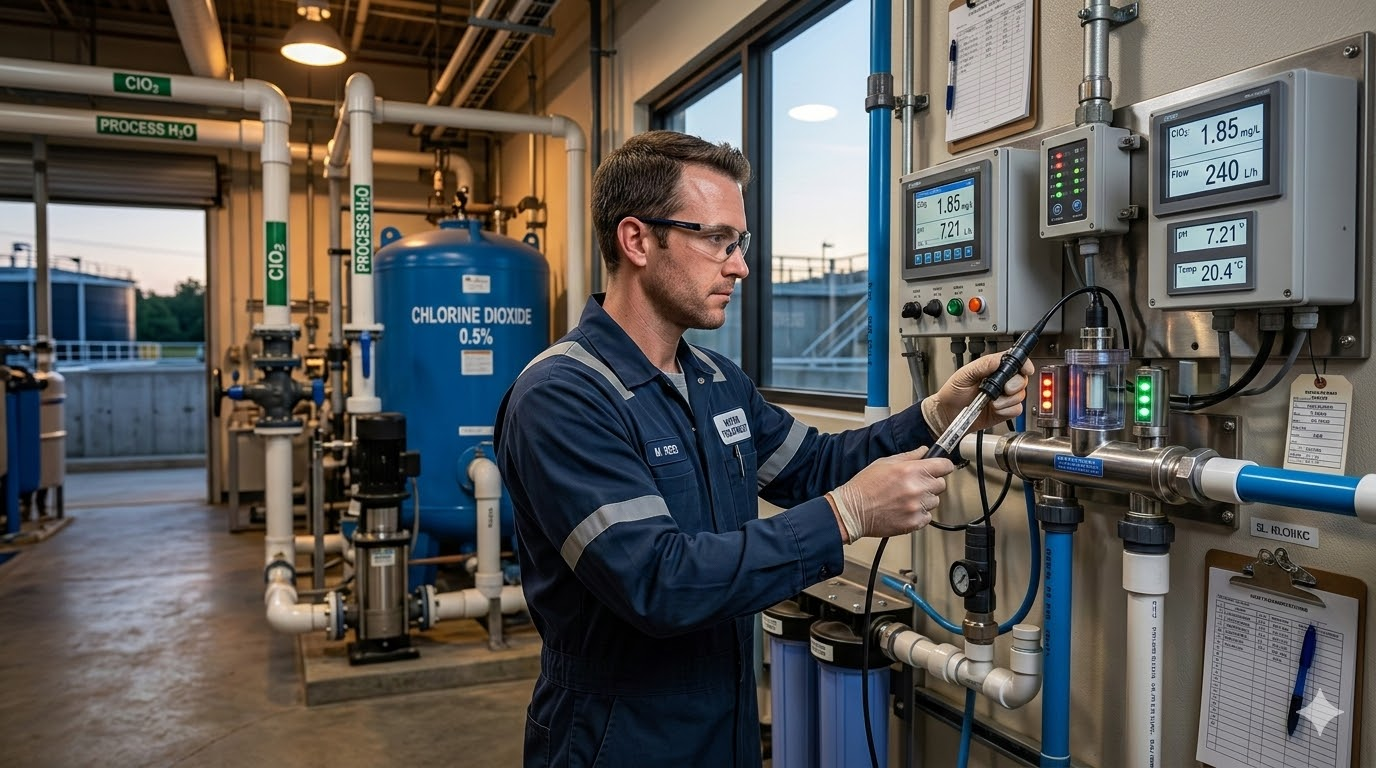
Chlorine dioxide is rapidly moving from a niche disinfectant to a mainstream choice in water treatment facilities worldwide. As regulations on disinfection byproducts tighten and operators seek more effective pathogen control, ClO2 adoption has accelerated across drinking water, wastewater, food processing, and aquaculture. But with that adoption comes a critical operational requirement: accurate, continuous monitoring of ClO2 residual concentrations.
In this guide, we cover everything you need to know about monitoring chlorine dioxide in water - from the chemistry behind it, to sensor technologies, regulatory thresholds, and how to integrate ClO2 monitoring into a modern IoT-based water treatment system.
What Is Chlorine Dioxide?
Chlorine dioxide (ClO2) is a yellow-green gas with strong oxidizing properties. Despite its name, it is chemically distinct from chlorine (Cl2). Where chlorine disinfects primarily through hypochlorous acid (HOCl) formation, ClO2 operates as a dissolved gas that attacks microorganisms through direct electron transfer - a fundamentally different mechanism.
This distinction matters for three practical reasons:
-
No THM or HAA formation. Chlorine reacts with natural organic matter (NOM) in water to produce trihalomethanes and haloacetic acids - regulated carcinogens under the EPA Stage 2 Disinfectants and Disinfection Byproducts Rule (DBPR). ClO2 does not form these compounds, making it attractive for source waters with high organic loading.
-
pH-independent efficacy. Free chlorine’s disinfecting power drops sharply above pH 7.5 as HOCl shifts to the less effective hypochlorite ion (OCl-). ClO2 maintains consistent biocidal activity across a pH range of 4 to 10, which is a significant advantage for systems dealing with alkaline source water or variable pH conditions.
-
Superior biofilm and protozoa control. ClO2 penetrates biofilm more effectively than chlorine and delivers higher CT (concentration x time) kill rates against resistant organisms like Cryptosporidium parvum oocysts and Giardia lamblia cysts. The EPA awards ClO2 a 2-log Cryptosporidium inactivation credit at practical doses - something free chlorine cannot achieve without impractical contact times.
The tradeoff is that ClO2 must be generated on-site (it cannot be stored or shipped as a compressed gas due to its explosive nature above 10% concentration in air) and its byproducts - primarily chlorite (ClO2-) and chlorate (ClO3-) - require their own monitoring and regulatory compliance.
Measurement Methods for Chlorine Dioxide
Accurate ClO2 measurement is more challenging than free chlorine measurement because of potential interference from other oxidants and the need to distinguish ClO2 from its byproducts. We see two primary approaches in the field.
Amperometric (Electrochemical) Sensors
Amperometric sensors are the standard for continuous online ClO2 monitoring. A typical sensor consists of a working electrode (usually gold or platinum), a reference electrode, and an electrolyte solution separated from the sample water by a gas-permeable membrane. ClO2 diffuses through the membrane and is reduced at the cathode, generating a current proportional to its concentration.
Advantages:
- Real-time, continuous measurement with response times of 30-90 seconds
- Typical accuracy of +/- 0.01 mg/L or +/- 5% of reading
- Measurement range from 0 to 20 mg/L (most drinking water applications operate in 0.1 to 1.0 mg/L)
- Direct integration with SCADA, PLCs, and IoT controllers via 4-20 mA or Modbus output
- Selective membranes minimize interference from free chlorine, ozone, and chloramines
Limitations:
- Membrane fouling in high-turbidity or high-iron water requires more frequent maintenance
- Electrolyte depletion necessitates periodic replacement (typically every 3-6 months)
- Temperature compensation is essential - a 1 degree C change can shift readings by approximately 3%
Colorimetric Methods
Colorimetric analysis remains the reference method for ClO2 verification and is widely used for grab samples, laboratory confirmation, and regulatory reporting.
DPD (N,N-diethyl-p-phenylenediamine) Method: The DPD method, standardized as EPA Method 327.0 and Standard Methods 4500-ClO2 D, uses the differential reaction of ClO2 and chlorine with DPD reagent. By measuring absorbance before and after adding glycine (which selectively removes free chlorine), the analyst can determine ClO2 concentration independently. Detection range is typically 0.05 to 5.0 mg/L.
Chlorophenol Red (CPR) Method: EPA Method 327.0 uses the decolorization of chlorophenol red by ClO2. It offers higher selectivity than DPD for ClO2 specifically, with minimal interference from free chlorine at concentrations below 5 mg/L. This is the EPA-preferred method for compliance monitoring.
Lissamine Green B (LGB) Method: An alternative colorimetric approach (Standard Methods 4500-ClO2 E) that provides good selectivity and a detection limit of approximately 0.05 mg/L.
Method Comparison
| Parameter | Amperometric Sensor | DPD Colorimetric | CPR (EPA 327.0) |
|---|---|---|---|
| Measurement type | Continuous online | Grab sample / bench | Grab sample / bench |
| Response time | 30-90 seconds | 2-5 minutes | 5-10 minutes |
| Detection range | 0-20 mg/L | 0.05-5.0 mg/L | 0.05-5.0 mg/L |
| ClO2 selectivity | Good (membrane) | Moderate (glycine step) | High |
| Free Cl2 interference | Low with proper membrane | Removed by glycine | Minimal below 5 mg/L |
| Automation potential | Direct 4-20 mA / digital | Requires online analyzer | Manual only |
| Maintenance interval | 1-4 weeks (cal), 3-6 months (membrane) | Per-test reagent | Per-test reagent |
| Capital cost | $1,500-$5,000 (sensor) | $500-$2,000 (photometer) | $500-$2,000 (photometer) |
For most operational environments, we recommend amperometric sensors for process control and continuous compliance monitoring, backed by periodic DPD or CPR grab samples for calibration verification.
Regulatory Requirements
Understanding the regulatory framework is essential for any facility using ClO2 as a disinfectant.
US EPA Standards
Under the Stage 1 and Stage 2 Disinfectants and Disinfection Byproducts Rules:
- ClO2 Maximum Residual Disinfectant Level (MRDL): 0.8 mg/L, measured at the entry point to the distribution system
- Chlorite Maximum Contaminant Level (MCL): 1.0 mg/L, monitored monthly at the entry point and quarterly in the distribution system
- Chlorate: Not currently regulated by the EPA, but the WHO recommends a guideline value of 0.7 mg/L and the EPA has placed chlorate on the Contaminant Candidate List (CCL 4)
Monitoring frequency: Daily ClO2 measurement at the treatment plant entrance to the distribution system. If ClO2 exceeds 0.8 mg/L, the system must notify consumers within 24 hours.
WHO Guidelines
The World Health Organization sets a provisional guideline value of 0.7 mg/L for ClO2 in drinking water, with a chlorite guideline of 0.7 mg/L. These values reflect the combined toxicological assessment of ClO2 and its inorganic byproducts.
European Union
The EU Drinking Water Directive (2020/2184) does not set a specific limit for ClO2 as a disinfectant residual but requires that disinfection byproducts - including chlorite at 0.7 mg/L - be controlled. Individual member states may set their own limits.
Byproduct Monitoring
This is where ClO2 monitoring gets more complex. When ClO2 reacts in water, it produces chlorite (ClO2-) as its primary byproduct - typically 50-70% of the applied ClO2 dose converts to chlorite. Chlorate (ClO3-) forms as a secondary byproduct, particularly in systems where ClO2 is generated using chlorine-based methods.
A complete ClO2 monitoring program must therefore track three analytes:
- ClO2 residual (process control and MRDL compliance)
- Chlorite (MCL compliance)
- Chlorate (best practice, anticipating future regulation)
Ion chromatography (EPA Method 300.1) is the standard laboratory method for chlorite and chlorate quantification. Some online analyzers now offer simultaneous ClO2/chlorite measurement using amperometric or photometric techniques.
Applications
Drinking Water Treatment
This is the largest and fastest-growing application for ClO2. Municipal water utilities adopt ClO2 as a primary disinfectant or pre-oxidant to reduce THM and HAA formation. Typical dosing ranges from 0.5 to 1.5 mg/L at the raw water intake, with a target residual of 0.2 to 0.4 mg/L entering the distribution system. Monitoring at the point of application, after the contact tank, and at the entry to distribution is standard practice.
Wastewater Treatment
ClO2 is used in wastewater for final effluent disinfection, particularly where chlorine residuals must be minimized to protect aquatic life. It is also effective for odor control (oxidation of hydrogen sulfide and mercaptans) and color removal in industrial wastewater. Dosing is typically higher (1-5 mg/L) and monitoring focuses on ensuring adequate disinfection while minimizing residual discharge.
Food and Beverage Processing
The FDA permits ClO2 as an antimicrobial agent for washing fruits, vegetables, and poultry. Concentrations used in food processing wash water typically range from 1 to 5 mg/L. Monitoring is critical for both food safety (ensuring adequate disinfection) and product quality (preventing off-flavors from excess dosing). Many food processing facilities use inline amperometric sensors with automated dosing feedback loops.
Aquaculture
In recirculating aquaculture systems (RAS), ClO2 is used for pathogen control in makeup water and for biofilm management in piping. The challenge in aquaculture is that ClO2 is toxic to fish at relatively low concentrations - LC50 values for most species fall between 0.1 and 0.5 mg/L. This means monitoring must be extremely precise, with alarms set to trigger well below lethal thresholds. Residual targets in aquaculture intake water after treatment are typically below 0.02 mg/L, requiring sensors with low-end detection capability.
Sensor Selection and Installation
Choosing the right ClO2 sensor depends on your application, water matrix, and integration requirements. Here is what we recommend evaluating.
Key Selection Criteria
- Measurement range: Match the sensor range to your operating range. A sensor rated 0-20 mg/L will have poor resolution at 0.1 mg/L. For drinking water applications, look for sensors with a 0-2 mg/L or 0-5 mg/L range.
- Selectivity: Ensure the sensor membrane and electrode chemistry are designed specifically for ClO2. Cross-sensitivity to free chlorine should be specified and ideally below 2% of the chlorine concentration.
- Response time (T90): For dosing control loops, a T90 under 60 seconds is preferred. For compliance monitoring, up to 120 seconds is acceptable.
- Temperature compensation: Automatic temperature compensation (ATC) is essential. Verify the sensor includes an integrated temperature element.
- Output options: 4-20 mA analog output is universal for SCADA integration. Digital outputs (Modbus RTU/TCP, SDI-12) provide higher resolution and diagnostic data.
- Certifications: For drinking water applications, look for NSF/ANSI 61 certification for wetted materials.
Installation Best Practices
Proper sensor placement is as important as sensor selection:
- Flow cell installation is preferred over direct immersion for most applications. A bypass flow cell with a constant flow rate of 15-30 L/hr ensures consistent sample delivery and protects the sensor from high-velocity flow damage.
- Install after filtration where possible. Particulate matter accelerates membrane fouling and reduces calibration intervals.
- Minimize sample transport distance. ClO2 decays in piping - especially in the presence of UV light or elevated temperatures. Keep the distance between the sampling point and the sensor under 3 meters, and use opaque tubing.
- Avoid air bubbles. Air entrainment on the sensor membrane causes erratic readings. Orient the flow cell to allow air to escape upward and install a bubble trap if necessary.
- Temperature equilibration. If the sample line passes through areas with significantly different ambient temperatures, insulate the tubing to prevent condensation and thermal shock to the sensor.
Maintenance Schedule
| Task | Frequency |
|---|---|
| Calibration verification (vs. grab sample) | Weekly |
| Full calibration (zero + span) | Every 1-4 weeks |
| Membrane inspection and cleaning | Monthly |
| Electrolyte replacement | Every 3-6 months |
| Membrane replacement | Every 6-12 months |
| O-ring and seal inspection | Every 6-12 months |
IoT Integration and Continuous Monitoring
Manual grab sampling alone cannot provide the temporal resolution needed for modern water treatment process control. A ClO2 event - whether a dosing system malfunction causing a spike or a demand surge causing residual to drop - can occur in minutes. Continuous online monitoring with IoT connectivity is the only way to catch these events in real time.
System Architecture
A typical IoT-enabled ClO2 monitoring setup consists of:
- Sensor probe - an amperometric ClO2 sensor such as our ClO2-100 probe installed in a bypass flow cell at the monitoring point
- Controller/transmitter - processes the raw sensor signal, applies temperature compensation, handles calibration data, and outputs both local display readings and digital communication
- IoT gateway or edge device - aggregates data from multiple sensors and controllers, applies local logic (alarms, dosing control), and transmits data to cloud platforms via cellular, Wi-Fi, or Ethernet
- Cloud platform - stores time-series data, provides dashboards, generates compliance reports, and sends alerts via SMS, email, or push notification
Data Logging and Compliance Reporting
Regulatory compliance increasingly requires documented, timestamped records of disinfectant residual. A well-configured monitoring system automatically logs ClO2 readings at intervals of 1-5 minutes, generates daily min/max/average reports, and flags any exceedance of the 0.8 mg/L MRDL. This eliminates manual data entry errors and provides an auditable record for state regulators.
Automated Dosing Control
The highest-value integration is closed-loop dosing control. The ClO2 sensor feeds real-time residual data to a PID controller that adjusts the ClO2 generator output to maintain a target residual setpoint. This approach typically reduces chemical consumption by 15-25% compared to flow-proportional dosing alone, while maintaining tighter residual control.
Multi-Parameter Monitoring
ClO2 monitoring rarely operates in isolation. Most treatment facilities also monitor pH (which affects ClO2 stability), ORP (as a secondary disinfection indicator), turbidity (which affects ClO2 demand), and temperature. Combining these parameters on a single IoT platform enables correlation analysis - for example, identifying that ClO2 demand spikes correlate with turbidity events from storm runoff.
For facilities also using ozone as part of a multi-barrier disinfection strategy, our dissolved ozone monitoring guide covers the complementary monitoring requirements and sensor technologies.
Conclusion
Chlorine dioxide is a powerful disinfectant with clear advantages over chlorine in many water treatment scenarios - no THM/HAA formation, pH-independent efficacy, and superior biofilm control. But these benefits are only realized with proper monitoring. Without accurate, continuous ClO2 measurement, operators risk regulatory violations from residual exceedances, inadequate disinfection from underdosing, and wasted chemical from overdosing.
The technology for reliable ClO2 monitoring is mature and accessible. Amperometric sensors provide the continuous data stream needed for process control and compliance, while colorimetric grab samples serve as the verification backbone. Integrated with modern IoT controllers and cloud platforms, a ClO2 monitoring system delivers real-time visibility, automated dosing optimization, and audit-ready compliance records.
Whether you are retrofitting ClO2 into an existing chlorine-based treatment plant or designing a new system from the ground up, we recommend starting with a clear monitoring plan that covers all three analytes (ClO2, chlorite, chlorate), specifies sensor placement at each critical control point, and defines calibration and maintenance protocols from day one. The upfront investment in monitoring infrastructure pays for itself quickly through reduced chemical costs, fewer compliance incidents, and more consistent water quality.