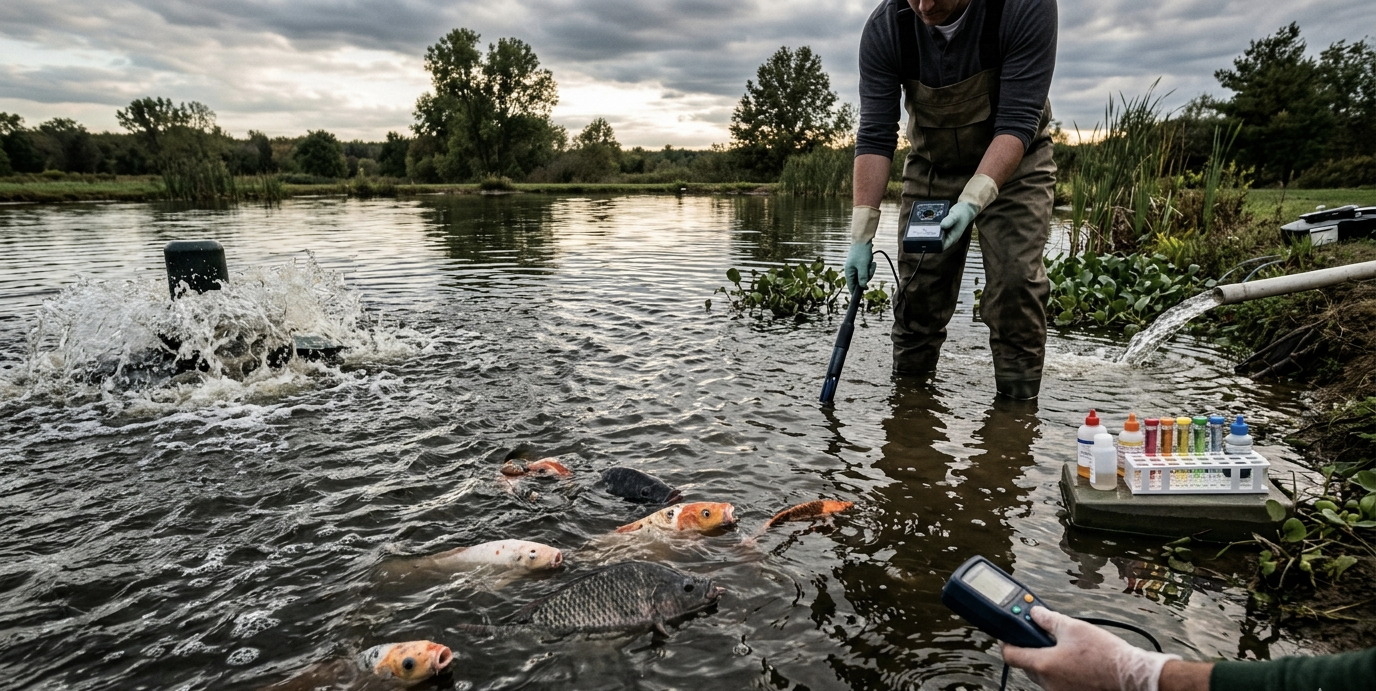
Two years ago, a barramundi farmer in Queensland lost 3,200 fish in 36 hours. His dissolved oxygen was fine. Temperature was normal. pH looked reasonable at 8.2. What killed the fish was an ammonia spike he never saw coming. He had treated the pond with an antibiotic five days earlier to address a bacterial gill infection, and the antibiotic had quietly wiped out the nitrifying bacteria colonies in his biological filter. Total ammonia nitrogen (TAN) crept from 0.5 mg/L to 4.8 mg/L over three days. At pH 8.2 and 28 degrees C, that 4.8 mg/L TAN meant about 0.65 mg/L of un-ionized ammonia, more than three times the lethal threshold for barramundi.
He tested ammonia on day one of the treatment and on day five. By day five, the fish were already showing hemorrhaging at the gill bases and had stopped eating entirely. The test kit confirmed the spike, but by then the damage was done and the surviving fish took weeks to recover.
Ammonia does not kill fish the way a dissolved oxygen crash does. A DO crash kills fast, often overnight, and the cause is obvious. Ammonia is slower, more insidious. Fish exposed to sub-lethal ammonia for days suffer gill damage, immune suppression, reduced growth, and increased susceptibility to every opportunistic pathogen in the water. The farmer who loses fish to ammonia often thinks it was a disease outbreak because the fish die over a period of days with disease-like symptoms. But the root cause was the water chemistry that nobody was monitoring.
This guide covers the nitrogen cycle in practical terms, what causes ammonia spikes, why pH is the factor most farmers get wrong when reading ammonia results, and what to do when you detect a spike. If you are running a RAS system specifically, also read our RAS water quality monitoring guide which covers biofilter management in detail.
The Nitrogen Cycle in 5 Minutes
Every fish farmer has heard about the nitrogen cycle. Most have a vague understanding that ammonia turns into nitrite and then nitrate. But the practical details matter when your fish are dying, so let us be specific.
Where ammonia comes from
Fish produce ammonia directly through their gills as a metabolic waste product. This is the primary source in any aquaculture system. A fish excretes roughly 25-35 grams of ammonia per kilogram of feed consumed. So if you are feeding 50 kg per day into a pond, your fish are producing roughly 12-17 grams of TAN daily.
The second source is decomposition. Uneaten feed, dead fish, dead algae, and fish feces all decompose, and that decomposition releases ammonia. In a pond system where you are feeding at 2-3% of body weight per day and achieving 80% feed conversion, roughly 20% of the feed is either uneaten or passes through the fish as feces. All of that decomposes into ammonia eventually.
The conversion process
Nitrifying bacteria convert ammonia to nitrite (Nitrosomonas species) and then nitrite to nitrate (Nitrobacter and Nitrospira species). In a pond, these bacteria colonize every submerged surface: the pond bottom, rocks, the sides, even suspended particles. In a RAS, they are concentrated in the biofilter.
This two-step conversion requires:
- Oxygen. Nitrification is an aerobic process. Below 2 mg/L DO, nitrification slows dramatically. Below 1 mg/L, it basically stops.
- Alkalinity. Nitrification consumes alkalinity at a rate of about 7.14 mg of alkalinity (as CaCO3) per mg of ammonia converted. If alkalinity drops below 80-100 mg/L, pH crashes and nitrification stalls.
- Stable pH above 6.8. Nitrifying bacteria slow significantly below pH 6.8 and stop almost entirely below pH 6.0.
- Temperature above 15 degrees C. Nitrification rate roughly doubles for every 10-degree increase between 10 and 30 degrees C.
When any of these conditions falls out of range, ammonia stops being converted and starts accumulating.
The 6 Most Common Causes of Ammonia Spikes
1. Overfeeding
This is the number one cause in pond systems. It is simple arithmetic: more feed in the water means more ammonia produced, both from fish metabolism and from decomposition of uneaten feed. Farmers who feed “a little extra to be safe” are actually increasing their ammonia risk. A pond that can biologically process the ammonia from 40 kg of feed per day will accumulate ammonia if you feed 60 kg.
Signs: water turns murky, feed still visible on the surface 15 minutes after feeding, increasing TAN readings over several days.
2. Dead fish decomposing in the pond
A single dead 500-gram fish decomposing on the pond bottom releases roughly 15-20 grams of ammonia over several days. In a mortality event where dozens of fish die (from handling stress, disease, or a partial oxygen crash), the decomposing biomass can cause a secondary ammonia spike that kills more fish than the original event.
This is why removing dead fish immediately is not just aesthetics. It is ammonia management.
3. Biofilter crash (RAS and biofloc systems)
The nitrifying bacteria in your biofilter are alive, and like any living organism, they can be killed. Common biofilter killers:
- Antibiotics and medications. Formalin, potassium permanganate, copper sulfate, and most antibiotics damage or kill nitrifying bacteria. The effect is often delayed by 2-5 days, which is why the farmer in our opening story did not see the ammonia spike until day three.
- Power outages. If water stops flowing through the biofilter for more than 4-6 hours, the bacteria begin dying from oxygen depletion. A biofilter that lost power overnight may look fine the next morning but will underperform for days.
- pH crashes. If pH drops below 6.0 for even a few hours, nitrifying bacteria populations can crash by 50% or more.
- Temperature shock. A sudden temperature change of more than 5 degrees C can significantly reduce nitrification rates.
4. New system syndrome
This is the RAS and biofloc equivalent of “new tank syndrome” in home aquariums. A newly started biofilter takes 4-8 weeks to develop a mature nitrifying bacteria population capable of handling the full ammonia load. Farmers who stock heavily into a new system before the biofilter has matured will see ammonia and nitrite spikes within the first two weeks.
5. Algae die-offs in ponds
A dense algae bloom that crashes (from weather change, nutrient depletion, or chemical treatment) releases stored nitrogen as the algae cells decompose. An algae bloom with a Secchi depth of 15 cm can contain 50-100 kg of nitrogen per hectare. When that crashes, you get an ammonia pulse that overwhelms the pond’s biological capacity.
6. Seasonal changes in pond systems
In temperate climates, ammonia spikes are common in early spring when water temperature rises enough to increase fish metabolism and feeding rates, but the nitrifying bacteria population has not yet ramped up from winter dormancy. The bacteria need weeks to rebuild their population after cold months, but farmers start feeding heavily as soon as fish show appetite.
Why pH Changes Everything: The NH3/NH4+ Relationship
This is the single most misunderstood aspect of ammonia in aquaculture. Total Ammonia Nitrogen (TAN), which is what your test kit or sensor measures, is the sum of two forms:
- NH4+ (ammonium): Ionized, relatively non-toxic
- NH3 (un-ionized ammonia): The form that crosses gill membranes and kills fish
The ratio between these two forms is controlled by pH and temperature. Higher pH and higher temperature shift the equilibrium toward the toxic NH3 form.
Here is a practical reference table showing the percentage of TAN that is in the toxic NH3 form:
| pH | 20C | 25C | 30C |
|---|---|---|---|
| 7.0 | 0.40% | 0.57% | 0.81% |
| 7.5 | 1.24% | 1.77% | 2.52% |
| 8.0 | 3.83% | 5.38% | 7.52% |
| 8.5 | 11.2% | 15.3% | 20.3% |
| 9.0 | 28.5% | 36.3% | 44.6% |
Look at the difference between pH 7.0 and pH 8.5 at 30 degrees C. At pH 7.0, only 0.81% of your TAN is toxic. At pH 8.5, over 20% is toxic. That means a TAN reading of 2 mg/L at pH 8.5 is 25 times more dangerous than the same reading at pH 7.0.
This is why you cannot interpret an ammonia reading without simultaneously knowing your pH. A pH sensor running alongside your ammonia monitoring is not optional. It is part of the same measurement.
The afternoon pH trap
In productive ponds with healthy algae blooms, pH rises during the afternoon as photosynthesis consumes CO2. It is common to see pH climb from 7.8 at dawn to 8.8 or even 9.0 by mid-afternoon. During this pH peak, any ammonia present in the water becomes dramatically more toxic.
A pond with 1.0 mg/L TAN at dawn (pH 7.8, 0.04 mg/L NH3) becomes a pond with 1.0 mg/L TAN at 3 PM (pH 8.8, 0.25 mg/L NH3). The total ammonia did not change at all, but the toxic fraction increased six-fold. Fish that seemed fine in the morning start showing stress by afternoon.
This is one reason why fish kills from ammonia often show up in late afternoon, not just during classical overnight DO crashes. For comprehensive guidance on understanding shrimp-specific interactions between ammonia, pH, and other parameters, see our shrimp farm water quality guide.
Detection: Sensors vs Test Kits
Test kits
Colorimetric test kits (Nessler or salicylate method) measure TAN with reasonable accuracy for grab samples. The problem is timing. A test kit tells you what ammonia was at the moment you ran the test. If you test once in the morning and the spike hits in the afternoon, you miss it entirely. And if you are testing because fish are already acting stressed, you are in reactive mode.
Test kit accuracy also degrades in saltwater, highly colored water, and water with high organic loads. Interference from chloramines can produce false readings.
Continuous sensor monitoring
Ion-selective electrode (ISE) sensors measure ammonium (NH4+) continuously. The NH4-100 probe takes readings every few minutes, logs the data, and can trigger alarms through a connected controller when TAN rises above your set threshold.
When paired with a continuous pH sensor, you can calculate the un-ionized ammonia fraction in real time. Some controller configurations can do this math automatically and alarm on calculated NH3, not just TAN. This is significantly more useful because it accounts for the pH-driven toxicity changes throughout the day.
An ORP sensor adds another layer of insight. Falling ORP values often correlate with rising ammonia because both indicate deteriorating water quality and reduced nitrification activity. ORP is not a direct ammonia measurement, but a sudden ORP drop can serve as an early warning that precedes the ammonia spike by hours.
Emergency Response: What to Do When Ammonia Spikes
You have detected an ammonia spike, either through a sensor alarm or a test kit reading. TAN is above 2 mg/L, pH is 8.0 or higher, and fish are showing signs of stress (flashing, gasping at the surface, reduced feeding, congregating near inflows). Here is the protocol.
Immediate actions (first 30 minutes)
1. Stop feeding. This is the single most impactful thing you can do. Every kilogram of feed you add produces more ammonia. Stop feeding completely for at least 48 hours, or until TAN drops below 1.0 mg/L.
2. Start a water exchange. If you have a clean water source, begin exchanging 25-50% of the pond volume. In a RAS, increase the water exchange rate. Fresh water dilutes the ammonia directly and is the fastest way to reduce TAN concentration.
3. Maximize aeration. Nitrifying bacteria need oxygen. Turn on every aerator available. Higher DO supports the bacteria that convert ammonia and helps stressed fish cope by ensuring they are not fighting both ammonia toxicity and low oxygen simultaneously.
4. Check pH and consider whether to adjust it. If pH is above 8.5, you have the option of carefully lowering it to reduce the toxic NH3 fraction. Adding hydrochloric acid or CO2 injection can lower pH, but this must be done gradually. Rapid pH changes cause their own stress. A pH reduction from 8.5 to 7.5 cuts the toxic ammonia fraction by about 80% at 25 degrees C. But do not drop pH below 6.8 or you will inhibit the nitrifying bacteria you need working.
Secondary actions (first 24 hours)
5. Remove dead fish and uneaten feed. Every decomposing organism and feed pellet on the bottom is producing more ammonia. Seine out dead fish. If accessible, vacuum or flush uneaten feed.
6. Apply detoxifiers if available. Commercial ammonia detoxifiers based on sodium thiosulfate temporarily bind ammonia into a less toxic form. These buy time but do not remove the ammonia from the system. They need to be reapplied every 24-48 hours.
7. Add nitrifying bacteria (for RAS/biofloc). If the spike was caused by a biofilter crash, inoculate the biofilter with a commercial nitrifying bacteria culture. This speeds recovery from weeks to days.
8. Monitor continuously. Take TAN and pH readings every 2-4 hours, or better, rely on continuous sensor readings. You need to know whether the ammonia is declining or still rising. If it is still rising after 12 hours despite water exchange and feeding cessation, you may need more aggressive water exchange or to reduce biomass through emergency harvest.
Recovery phase (days 2-7)
Resume feeding at 25% of normal rates on day three, assuming TAN is below 1.0 mg/L. Increase by 25% every two days while monitoring TAN and nitrite. Watch for a secondary nitrite spike, which is common 3-7 days after an ammonia spike as the nitrifying bacteria that convert ammonia to nitrite recover faster than the bacteria that convert nitrite to nitrate.
Prevention: Keeping Ammonia Under Control
Feed management
Feed is the primary nitrogen input to your system. Reduce it and you reduce ammonia production proportionally.
- Use high-quality feed with good digestibility (higher digestibility means less waste nitrogen)
- Feed to satiation, not to a fixed amount. If fish stop eating within 10 minutes, that is enough
- Use automatic feeders that distribute small amounts frequently rather than dumping large amounts that sink and decompose
- Adjust feeding rate down during hot weather, after handling stress, or during disease treatment
Stocking density management
Higher stocking density means more ammonia per unit of water volume. If you are consistently fighting ammonia spikes, you may be overstocked for your system’s biological carrying capacity. Reducing density by 20% can reduce ammonia load enough to keep it within manageable ranges.
Biofilter maintenance (RAS)
- Never treat fish in the biofilter loop. Isolate fish for medication treatment or bypass the biofilter during chemical treatments
- Monitor biofilter DO. Keep it above 2 mg/L at all times
- Maintain alkalinity above 100 mg/L CaCO3 to buffer against pH drops
- Never clean more than one-third of the biofilter media at a time
Continuous monitoring
The single best prevention strategy is continuous ammonia monitoring paired with pH monitoring. An NH4-100 sensor connected to an Omni Exodus controller can alert you to rising ammonia trends before they become emergencies. Set your alarm threshold at 1.0 mg/L TAN for freshwater systems at pH above 8.0, or at 1.5 mg/L TAN for systems maintained below pH 7.5.
For a complete overview of all the parameters you should be monitoring, see our aquaculture water quality monitoring guide.
When Ammonia and DO Problems Hit Together
The worst-case scenario, and it happens more often than people expect, is a simultaneous ammonia spike and dissolved oxygen crash. This typically occurs after an algae die-off: the decomposing algae consume oxygen and release ammonia at the same time. Fish are hit with two stressors simultaneously, and mortality is rapid.
If you are monitoring only DO or only ammonia, you miss half the picture. A monitoring system that tracks DO, pH, and ammonia together gives you the complete water quality picture and lets you respond to the actual cause, not just the most obvious symptom.
Our buyer’s guide for aquaculture monitoring systems covers how to build a multi-parameter monitoring setup that protects against these compound failure scenarios.