THS-100 עם Arduino, ESP32, Raspberry Pi ו-Python
איך מחברים את חיישן טמפרטורה ולחות RS485 THS-100 למיקרו-בקר או למחשב שלכם וקוראים ממנו ב-RS485 Modbus RTU. הטבלאות הן אלה שבדף הנתונים, ושתי דוגמאות הקוד מורצות מול מסגרת הדוגמה שבדף הנתונים לפני שהעמוד מתפרסם.
עמוד המוצר דף נתונים (PDF) דף נתונים (Markdown) סקיצת Arduino (.ino) סקריפט Python (.py)
חיבור ה-THS-100
החיישן הוא התקן RS485, ולכן צריך משדר-מקלט בינו לבין הלוח שלכם. במחשב או ב-Raspberry Pi זה מתאם USB ל-RS485. במיקרו-בקר זה מודול מסוג MAX485 על יציאה טורית חומרתית. הזינו את החיישן מספק שנמצא בטווח המתח שבטבלה, וחברו את האדמה שלו לאדמה של המשדר-מקלט.
| Wire Color | Function | Description |
|---|---|---|
| Red | V+ | Power Supply (5-28 V DC) |
| Black | GND | Power Ground |
| Yellow | RS485-A | Data+ |
| Green | RS485-B | Data- |
Do not swap the A and B data lines. On long runs or buses with many devices, power the sensors locally and fit a 120 Ω termination resistor at the end of the bus.
דוגמת Python (Raspberry Pi, Linux, macOS, Windows)
הסקריפט צריך רק את pyserial. הוא בונה בעצמו את בקשת ה-Modbus, בודק את ה-CRC של התשובה ומדפיס קריאה אחת כל חמש שניות. ב-Windows העבירו את יציאת ה-COM כארגומנט.
#!/usr/bin/env python3
"""Read the Agrinovo THS-100 over RS485 Modbus RTU.

Works on a Raspberry Pi or any computer with a USB to RS485 adapter.
Install the serial library once:  pip install pyserial
Run:  python3 ths_100.py /dev/ttyUSB0
"""
import struct
import sys
import time

import serial

PORT = sys.argv[1] if len(sys.argv) > 1 else "/dev/ttyUSB0"
ADDRESS = 0x01  # the sensor's Modbus address


def crc16(frame: bytes) -> bytes:
    crc = 0xFFFF
    for byte in frame:
        crc ^= byte
        for _ in range(8):
            crc = (crc >> 1) ^ 0xA001 if crc & 1 else crc >> 1
    return struct.pack("<H", crc)


def read_registers(port, address, function, start, count):
    request = struct.pack(">BBHH", address, function, start, count)
    port.reset_input_buffer()
    port.write(request + crc16(request))
    reply = port.read(5 + 2 * count)
    if len(reply) >= 5 and reply[1] == function | 0x80:
        raise IOError(f"sensor returned Modbus error {reply[2]}")
    if len(reply) != 5 + 2 * count or crc16(reply[:-2]) != reply[-2:]:
        raise IOError("no valid reply from the sensor")
    return reply[3:-2]


def read_probe(port):
    data = read_registers(port, ADDRESS, 0x03, 0x0000, 2)
    return {
        "temperature": struct.unpack(">h", data[2:4])[0] * 0.1,  # °C
        "humidity":    struct.unpack(">H", data[0:2])[0] * 0.1,  # % RH
    }


if __name__ == "__main__":
    with serial.Serial(PORT, 9600, bytesize=8, parity="N", stopbits=1, timeout=1) as port:
        while True:
            print(read_probe(port))
            time.sleep(5)
דוגמת Arduino (Uno, Mega, ESP32, ESP8266, MKR, Pico)
הסקיצה משתמשת בספריית Agrinovo: ב-Arduino IDE פתחו את Sketch > Include Library > Manage Libraries והתקינו את "Agrinovo". הספרייה בוחרת את היציאה הטורית לפי הלוח, והפינים רשומים בראש הקובץ AgrinovoDefaultPort.h. DE ו-RE של המשדר-מקלט מתחברים לפין יציאה אחד.
// Agrinovo THS-100 temperature and humidity sensor
// Prints temperature and humidity every 5 seconds.
//
// Sensor cable
//   Red     supply +, 5-28 V DC
//   Black   supply ground, joined to the board's ground
//   Yellow  RS485 A
//   Green   RS485 B
//
// The board talks to the sensor through an RS485 transceiver (MAX485 or
// similar). AgrinovoDefaultPort.h lists the serial pins used on each board.
//
// https://agrinovo.io/products/sensors/environmental/ths-100-rs485-temperature-humidity-sensor/

#include <Agrinovo.h>
#include <AgrinovoDefaultPort.h>

const int DE_PIN = 4;  // transceiver DE and RE, tied together

AgrinovoBus bus(AGRINOVO_PORT, DE_PIN);
AgrinovoTHS100 sensor(bus);  // Modbus address 1

void setup() {
  Serial.begin(115200);
  agrinovoPortBegin(9600);
  bus.begin();
}

void loop() {
  if (sensor.read()) {
    Serial.print("Temperature: ");
    Serial.print(sensor.temperature(), 1);
    Serial.println(" °C");
    Serial.print("Humidity: ");
    Serial.print(sensor.humidity(), 1);
    Serial.println(" % RH");
  } else {
    Serial.println(sensor.errorText());
  }
  delay(5000);
}
מה הדוגמאות קוראות
שתי הדוגמאות שולחות בקשה אחת, פונקציה 0x03, 2 רגיסטרים החל מ-0x0000, ומפענחות את הערכים האלה:
| ערך | יחידה | רגיסטר | קידוד |
|---|---|---|---|
| Temperature | °C | 0x0001 | מספר שלם של 16 סיביות עם סימן, עם מקדם קנה מידה |
| Humidity | % RH | 0x0000 | מספר שלם של 16 סיביות ללא סימן, עם מקדם קנה מידה |
כלי Modbus אחרים
אותה בקשה עובדת מכל מאסטר Modbus RTU: pymodbus, minimalmodbus, Node-RED, LabVIEW, בקר מתוכנת (PLC) או דאטה לוגר של צד שלישי עם יציאת Modbus. השתמשו בהגדרות התקשורת הטורית, בקוד הפונקציה ובכתובות הרגיסטרים שלמעלה.
איסוף נתונים בלי לכתוב קוד
בקר Omni Genesis קורא את ה-THS-100 ושולח את הקריאות לענן Agrinovo ברשת הסלולרית, ומשם אפשר לייצא אותן או לקרוא אותן דרך ה-API של הענן.
מתוך דף הנתונים
Specifications
| Parameter | Specification |
|---|---|
| Temperature Range | -40 to +80°C |
| Temperature Accuracy | ±0.3°C (at 25°C) |
| Temperature Resolution | 0.1°C |
| Humidity Range | 0-100% RH (non-condensing) |
| Humidity Accuracy | ±3% RH (at 60% RH, 25°C) |
| Humidity Resolution | 0.1% RH |
| Response Time | ≤15 s temperature, ≤4 s humidity (1 m/s airflow) |
| Measurement Refresh | 2 s |
| Long-term Stability | ≤0.1°C/year, ≤1% RH/year |
| Output | RS485, Modbus-RTU |
| Supply Voltage | 5-28 V DC |
| Power Consumption | ≤0.05 W |
| Protection | Reverse-polarity protection on supply |
| Cable | 4-wire, 1 m standard |
Probe Options
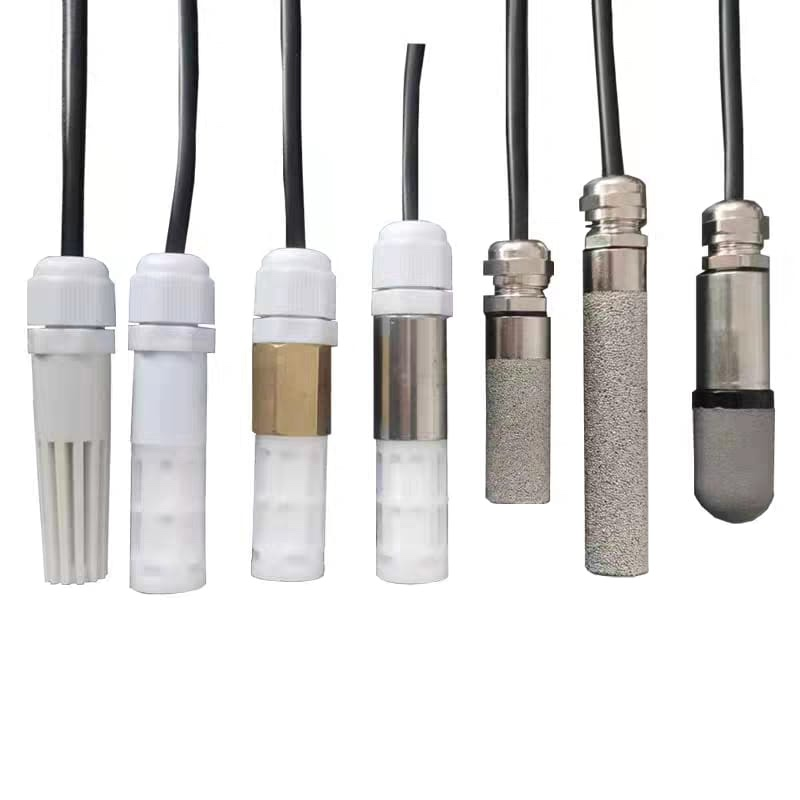
The THS-100 electronics are identical across all housings. Select the probe housing for the environment; specifications and communication are the same for every option.
| Ordering Code | Housing | Dimensions | Environment |
|---|---|---|---|
| THS-100-PVC | Vented PVC cap | Ø12.5 × 68 mm | Indoor air; fastest response; not waterproof |
| THS-100-PP | Sealed polymer | Ø15 × 67 mm | High humidity and outdoor; rain and fog |
| THS-100-BR | Brass body | Ø15 × 68 mm | High humidity and outdoor; rain and fog |
| THS-100-SS | Stainless steel body | Ø15 × 76 mm | High humidity and outdoor; rain and fog |
| THS-100-SM57 | Sintered metal filter | Ø14 × 57 mm | High-dust areas; fast response |
| THS-100-SM87 | Sintered metal filter, long | Ø14 × 87 mm | High-dust areas |
| THS-100-IP67 | IP67 sintered housing | Ø16.5 × 74 mm | Harsh and washdown environments |
Response time is specified with the vented PVC cap. Sealed and sintered housings protect the element in wet and dusty conditions and respond more gradually to fast humidity changes.
Communication Settings
| Parameter | Value |
|---|---|
| Protocol | Modbus-RTU |
| Baud Rate | 9600 bps (default); 2400, 4800 selectable |
| Data Bits | 8 |
| Parity | None |
| Stop Bits | 1 |
| Error Check | CRC-16 |
| Default Address | 0x01 |
Multiple sensors share one RS485 bus, each with a unique address (1-254). Bus length up to 2000 m with proper cabling and termination.
Register Map
Measurement Registers (Function 0x03)
| Address | Description | Scaling |
|---|---|---|
| 0x0000 | Humidity | Value ÷ 10 (% RH) |
| 0x0001 | Temperature | Value ÷ 10 (°C), two’s complement below 0°C |
Configuration Registers (Function 0x03 read / 0x06 write)
| Address | Description | Values |
|---|---|---|
| 0x0100 | Device Address | 1-254, default 1 |
| 0x0101 | Baud Rate | 2: 2400, 3: 4800, 4: 9600 |
| 0x0104 | Temperature Offset | Value ÷ 10 (°C), two’s complement |
| 0x0105 | Humidity Offset | Value ÷ 10 (% RH), two’s complement |
Reading Data
Read humidity and temperature (2 registers from 0x0000):
Request:  01 03 00 00 00 02 C4 0B
Response: 01 03 04 01 E6 FF 9F 1B A0
Decoding:
| Value | Hex | Decimal | Scaling | Result |
|---|---|---|---|---|
| Humidity | 0x01E6 | 486 | ÷10 | 48.6% RH |
| Temperature | 0xFF9F | -97 | ÷10 | -9.7°C |
Negative temperatures are transmitted in two’s complement: 0xFF9F = -97, giving -9.7°C.
Configuration
Change Address (0x01 → 0x02)
Write to register 0x0100:
01 06 01 00 00 02 09 F7
Note: Communication resumes on the new address.
Change Baud Rate (set 9600)
Write to register 0x0101:
01 06 01 01 00 04 D8 35
Offset Adjustment
Field-trim readings against a reference by writing an offset. Example, temperature offset of -0.5°C (0xFFFB) to register 0x0104:
01 06 01 04 FF FB C9 84
Humidity offset works the same way through register 0x0105.
Revision History
| Rev | Date | Changes |
|---|---|---|
| 1.0 | June 2026 | Initial release |
| 1.1 | August 2026 | Layout revision |
| 1.2 | October 2026 | New layout |
Contact
Agrinovo, https://agrinovo.io/products, [email protected], +972 54 688 8148 (direct / WhatsApp). Specifications subject to change without notice.
שאלות על החיווט או על הפרוטוקול?
ספרו לנו באיזה לוח או דאטה לוגר אתם משתמשים ומה צריך למדוד.